Sunday, May 1, 2011

Blessed Pope John Paul the Great


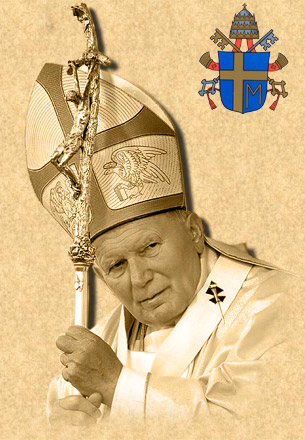
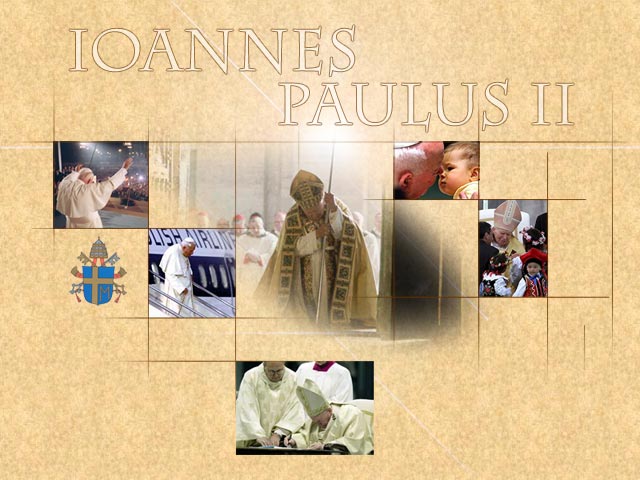
 BLESSED JOHN PAUL II, POPE

Charles Joseph Wotjtyła was born in 1920 in Wadowice, Poland. After his ordination to the priesthood and theological studies in Rome, he returned to his homeland and resumed various pastoral and academic tasks. He became first auxiliary bishop and, in 1964, Archbishop of Krakow and took part in the Second Vatican Council. On 16 October 1978 he was elected pope and took the name John Paul II. His exceptional apostolic zeal, particularly for families, young people and the sick, led him to numerous pastoral visits throughout the world. Among the many fruits which he has left as a heritage to the Church are above all his rich Magisterium and the promulgation of the Catechism of the Catholic Church as well as the Code of Canon Law for the Latin Church and for the Eastern Churches. In Rome on 2 April 2005, the eve of the Second Sunday of Easter (or of Divine Mercy), he departed peacefully in the Lord.

Common of Pastors: For a Pope.

Office of readings

Second reading

From the Homily of Blessed John Paul II, Pope, for the Inauguration of his Pontificate

(22 October 1978: AAS 70 [1978], 945-947)

Do not be afraid. Open wide the doors for Christ.

Peter came to Rome! What else but obedience to the inspiration received from the Lord could have guided him and brought him to this city, the heart of the Empire? Perhaps the fisherman of Galilee did not want to come here. Perhaps he would have preferred to stay there, on the shores of Lake of Genesareth, with his boat and his nets. Yet guided by the Lord, obedient to his inspiration, he came here!

According to an ancient tradition, Peter tried to leave Rome during Nero’s persecution. However, the Lord intervened and came to meet him. Peter spoke to him and asked. “Quo vadis, Domine?” — “Where are you going, Lord?” And the Lord answered him at once: “I am going to Rome to be crucified again.” Peter went back to Rome and stayed here until his crucifixion.

Our time calls us, urges us, obliges us, to gaze on the Lord and to immerse ourselves in humble and devout meditation on the mystery of the supreme power of Christ himself.

He who was born of the Virgin Mary, the carpenter’s Son (as he was thought to be), the Son of the living God (as confessed by Peter), came to make us all “a kingdom of priests”.

The Second Vatican Council has reminded us of the mystery of this power and of the fact that Christ’s mission as Priest, Prophet-Teacher and King continues in the Church. Everyone, the whole People of God, shares in this threefold mission. Perhaps in the past the tiara, that triple crown, was placed on the Pope’s head in order to signify by that symbol the Lord’s plan for his Church, namely that all the hierarchical order of Christ’s Church, all “sacred power” exercised in the Church, is nothing other than service, service with a single purpose: to ensure that the whole People of God shares in this threefold mission of Christ and always remains under the power of the Lord; a power that has its source not in the powers of this world, but instead in the mystery of the Cross and the Resurrection.

The absolute, and yet sweet and gentle, power of the Lord responds to the whole depths of the human person, to his loftiest aspirations of intellect, will and heart. It does not speak the language of force, but expresses itself in charity and truth.

The new Successor of Peter in the See of Rome today makes a fervent, humble and trusting prayer: Christ, make me become and remain the servant of your unique power, the servant of your sweet power, the servant of your power that knows no dusk. Make me a servant: indeed, the servant of your servants.

Brothers and sisters, do not be afraid to welcome Christ and accept his power. Help the Pope and all those who wish to serve Christ and with Christ’s power to serve the human person and the whole of mankind.

Do not be afraid. Open, I say open wide the doors for Christ. To his saving power open the boundaries of states, economic and political systems, the vast fields of culture, civilization and development. Do not be afraid. Christ knows “that which is in man”. He alone knows it.

So often today, man does not know that which is in him, in the depths of his mind and heart. So often he is uncertain about the meaning of his life on this earth. He is assailed by doubt, a doubt which turns into despair. We ask you, therefore, we beg you with humility and with trust, let Christ speak to man. He alone has words of life, yes, of life eternal.

Responsory

R/. Do not be afraid. The Redeemer of mankind has revealed the power of the Cross and has given his life for us. * Open, open wide the doors for Christ.

V/. In the Church we are called to partake of his power. * Open, open wide the doors for Christ.

Oration

O God, who are rich in mercy and who willed that the blessed John Paul the Second should preside as Pope over your universal Church, grant, we pray, that instructed by his teaching, we may open our hearts to the saving grace of Christ, the sole Redeemer of mankind. Who lives and reigns.

MAY DEVOTION: Day One - The Immaculate Conception


1st Day — Mary's Immaculate Conception

The Lord God said to the serpent: I will put enmities between thee and the woman. (Gen. iii. 14, 15.)

1. In these words the Immaculate Conception of the Blessed Virgin Mary was announced to our first parents. It was to be the reversal of the friendship with the serpent contracted by Eve, when she listened to his voice and fell under his power.

The second Eve was never to be under the power of the devil; the enmity between them was to admit of no possible exception. This involved the grace of being conceived immaculate..

2. Mary's Immaculate Conception was the foundation of all her graces. The absence of any stain or spot of sin distinguished her from all the rest of mankind. It distinguished her from the holiest of the saints, since they, one and all, were sinners. Her perfect sinlessness was the source of all her glory and all her majesty; it was this which opened the door to the unlimited graces that she received from God; it was this that qualified her for her divine maternity, and raised her to her throne as Queen of heaven.

3. If sinlessness is so priceless a treasure, how I ought to value it! And how I ought to hate sin with a deadly hatred, and to detest and avoid even what are called little sins!

Learn from Mary immaculate the holiness which God requires in those whom He chooses as His own. Pray Him to cleanse you more and more from the least stain of sin, and add your own endeavor.

"Simple and chaste should be those eyes which are accustomed to behold the body of Christ." — Imitation.

The purity of Blessed John Berchmans' soul beamed so brightly from his face that persons passing him in the streets would stop to ask his prayers. As a child he had vowed to live a virgin for Mary's sake, and thenceforth he kept his senses sealed to things of earth. During his three years in Rome he never raised his eyes to witness any spectacle, save that of Corpus Christi. He never passed Our Lady's statue without saluting it, nor left a church without visiting her altar. At even,' meal before tasting food, and at night before composing himself to sleep, he said a Hail Mary in honor of the Immaculate Conception; and to this practice he ascribed his exemption from all temptations of the flesh. He invented a Rosary in honor of that mystery, and made a vow, signed with his blood, ever to defend its truth. At the age of twenty-two he was already ripe for heaven, and went to his reward.

How eagerly should I cry out to the immaculate Mother of God, this day and every day, in words that she herself suggested to one of her servants:

O Mary, conceived without sin,
Pray for us who have recourse to thee!

Blessed Pope John Paul II's Spiritual Testament 1979


Totus Tuus ego sum

In the Name of the Most Holy Trinity. Amen.

"Watch, therefore, for you do not know on what day your Lord is coming" (Mt 24: 42) - these words remind me of the last call that will come at whatever time the Lord desires. I want to follow Him and I want all that is part of my earthly life to prepare me for this moment. I do not know when it will come but I place this moment, like all other things, in the hands of the Mother of my Master: Totus Tuus. In these same motherly hands I leave everything and Everyone with whom my life and my vocation have brought me into contact. In these Hands I above all leave the Church, and also my Nation and all humankind. I thank everyone. I ask forgiveness of everyone. I also ask for prayers, so that God's Mercy may prove greater than my own weakness and unworthiness.

During the spiritual exercises I reread the Testament of the Holy Father Paul VI. It was reading it that gave me the incentive to write this Testament.

I leave no possessions of which it will be necessary to dispose. As for the things I use every day, I ask that they be distributed as seems appropriate. Let my personal notes be burned. I ask that Fr Stanis³aw see to this, and I thank him for his help and collaboration, so understanding for so many years. On the other hand, I leave all my other "thank yous" in my heart before God Himself, because it is difficult to express them.

With regard to my funeral, I repeat the instructions that were given by the Holy Father Paul VI (here a note in the margin says: burial in the ground and not in a sarcophagus, 13 March 1992). Let the College of Cardinals and my Fellow Citizens decide on the place.

"apud Dominum misericordia
et copiosa apud Eum redemptio"

John Paul PP. II

Rome, 6 March 1979

After my death I ask for Holy Masses and prayers

5 February 1990

DIVINE MERCY SUNDAY


Among all of the elements of devotion to The Divine Mercy requested by our Lord through Sr. Faustina, the Feast of Mercy holds first place. The Lord's will with regard to its establishment was already made known in His first revelation to the saint. In all, there were 14 revelations concerning the desired feast.

In fact, Jesus Himself dictated the intentions for each day of the novena which he desired to be celebrated as a preparation for the solemn observance of this feast. Once after insisting, "Do all you possibly can for this work of mercy," Jesus added: "My Heart rejoices on account of this feast." Sister Faustina concluded: "After these words, I understood that nothing can dispense me from the obligation which the Lord demands of me" (Diary, 998).

Our Lord's explicit desire is that this feast be celebrated on the first Sunday after Easter. He joins the feast to the designated Sunday in eight revelations: Diary, 49, 88, 280, 299, 341, 570, 699, and 742. He also implies a connection between the feast and that Sunday on some other occasions recorded in the saint's Diary (see Diary, 420, 89).

The "First Sunday after Easter" which is designated in "The Liturgy of the Hours and the Celebration of the Eucharist" as the "Octave Day of Easter" was officially called the Second Sunday of Easter after the liturgical reform of Vatican II. Now, by the Decree of the Congregation for Divine Worship and the Discipline of the Sacraments, the name of this liturgical day has been changed to: "Second Sunday of Easter, or of Divine Mercy."

Pope John Paul II made the surprise announcement of this change in his homily at the canonization of Sr. Faustina on April 30, 2000. There, he declared: "It is important then that we accept the whole message that comes to us from the word of God on this Second Sunday of Easter, which from now on throughout the Church, will be called 'Divine Mercy Sunday.' "

By the words "the whole message," the Holy Father was referring to the strict connection between the "Easter Mystery of the Redemption" the suffering, death, burial, resurrection, and ascension of Christ, followed by the sending of the Holy Spirit and this Feast of Divine Mercy, the Octave Day of Easter.

In this regard, the Holy Father also said, citing the Responsorial Psalm of the Liturgy, "The Church sings ... , as if receiving from Christ's lips these words of the Psalm" [that is, Give thanks to the Lord for He is good; His steadfast love (=mercy) endures forever, Ps 118:1]. And then, the Holy Father developed the connection further: "[This comes] from the lips of the risen Christ, who bears the great message of Divine Mercy and entrusts its ministry to the Apostles in the Upper Room: 'Peace be with you. As the Father has sent Me, even so I send you. ... Receive the Holy Spirit. If you forgive the sins of any, they are forgiven; if you retain the sins of any, they are retained' " (Jn 20:2123).

By what the Holy Father continued to say, it becomes clear why Jesus insisted that the sacred image of Himself as The Divine Mercy is to be venerated throughout the world in connection with the observance of this Sunday (see Diary, 49, 88, 299, 341, 570, 742). The Holy Father said: "Before speaking these words, Jesus shows His hands and His side. He points, that is, to the wounds of the Passion, especially the wound in His Heart, the source from which flows the great wave of mercy poured out on humanity.

"From that Heart, Sr. Faustina Kowalska, the blessed whom from now on we will call a saint, will see two rays of light shining from that Heart and illuminating the world: 'The two rays,' Jesus Himself explained to her one day, 'represent blood and water' (Diary, 299).

"Blood and water! We immediately think of the testimony given by the Evangelist John, who, when a soldier on Calvary pierced Christ's side with his spear, sees blood and water flowing from it (cf. Jn 19:34). Moreover, if the blood recalls the sacrifice of the Cross and the gift of the Eucharist, the water, in Johannine symbolism, represents not only Baptism but also the gift of the Holy Spirit (cf. Jn 3:5; 4:14; 7:3739).

"Divine Mercy reaches human beings through the Heart of Christ crucified: 'Tell, My daughter, [all people] that I am Love and Mercy itself [personified]' Jesus will ask of Sr. Faustina (Diary, 1074). Christ pours out this mercy on humanity through the sending of the Spirit who, in the Trinity, is the PersonLove. And is not mercy love's 'second name' (cf. Rich in Mercy, n.7), understood in its deepest and most tender aspect, in its ability to take upon itself the burden of any need and, especially, in its most immense capacity for forgiveness?"

From this teaching of the Holy Father on that most solemn occasion of his "presenting the life and witness of Sr. Faustina Kowalska. to the whole Church as a gift of God to our time," it can be deduced that the most opportune time, the most proper one, for the solemn honoring of The Divine Mercy falls immediately after the Paschal Feast of Easter, recalling the attaining of our Redemption.

St. Augustine called the eight days of Easter (which the Church liturgically considers as constituting a single day the day of the new creation) "days of mercy and pardon." He calls the Sunday of this Paschal Octave (which our Lord insisted with St. Faustina is the Feast of Mercy [Diary, 88]) "the summary of the days of mercy" (Sermon 156, Dom. In Albis). It is no wonder, then, that already during his pilgrimage to Blessed Faustina's tomb on June 7, 1997, Pope John Paul 11 declared: "I give thanks to Divine Providence that I have been enabled to contribute personally to the fulfillment of Christ's will through the institution of the Feast of Divine Mercy."

Veneration of the Image

The image of Jesus, The Divine Mercy, is to have a special place of honor on the Feast of Mercy, a visual reminder of all that Jesus did for us through His Passion, Death, and Resurrection ... and a reminder, too, of what He asks of us in return to trust Him and be merciful to others:

"I want the image to be solemnly blessed on the first Sunday after Easter, and I want it to be venerated publicly so that every soul may know about it" (341).

A Special Promise of Mercy

Our Lord's promise to grant complete forgiveness of sins and punishment on the Feast of Mercy is recorded three times in the Diary of Saint Faustina, each time in a slightly different way:

"I want to grant a complete pardon to the souls that will go to Confession and receive Holy Communion on the Feast of My mercy" (1109).

"Whoever approaches the Fountain of Life on this day will be granted complete forgiveness of sins and punishment" (300).

"The soul that will go to Confession and receive Holy Communion will obtain complete forgiveness of sins and punishment" (699).

Extraordinary Graces

Our Lord is emphasizing, through this promise, the infi­nite value of Confession and Communion as miracles of mercy. He wants us to realize that since the Eucharist is His own Body, Blood, Soul, and Divinity, it is the "Fountain of Life" (300). The Eucharist is Jesus, Himself, the Living God, longing to pour Himself as Mercy into our hearts.

Why would Our Lord feel the need to emphasize this? Because so many people do not really understand it. They either see no need to receive Holy Communion, or they receive it simply out of habit. As St. Paul explains in his letter to the Corinthians, they eat the bread or drink the  cup of the Lord unworthily, "without recognizing the body of the Lord" (I Cor 11:2729).

In His revelations to Saint Faustina Our Lord makes it very clear what He is offering us in Holy Communion and how much it hurts Him when we treat His presence with indifference:

"My great delight is to unite Myself with souls ... When I come to a human heart in Holy Communion, My hands are full of all kinds of graces which I want to give to the soul. But souls do not even pay any attention to Me; they leave Me to Myself and busy themselves with other things. Oh, how sad I am that souls do not recognize Love! They treat Me as a dead object" (1385) ...

"It pains Me very much when religious souls receive the Sacrament of Love merely out of habit, as if they did not distinguish this food. I rind neither faith nor love in their hearts. I go to such souls with great reluctance. It would be better if they did not receive Me" (1288) ...

"How painful it is to Me that souls so seldom unite themselves to Me in Holy Communion. I wait for souls, and they are indifferent toward Me. I want to lavish My graces on them, and they do not want to accept them. They treat me as a dead object, whereas My Heart is full of love and mercy. In order that you may know at least some of My pain imagine the most tender of mothers who has great love for her children, while those children spurn her love. Consider her pain. No one is in a position to console her. This is but a feeble image and likeness of My love" (1447).

So, Our Lord's promise of complete forgiveness is both a reminder and a call. It is a reminder that He is truly present and truly alive in the Eucharist, filled with love for us and waiting for us to turn to Him with trust. And it is a call for us all to be washed clean in His Love through Confession and Holy Communion no matter how terrible our sins and begin our lives again. He is offering us a new start.

Prepare Yourself Properly

Going to Confession is not the only way we should prepare ourselves for Divine Mercy Sunday. As Cardinal Francis Macharski, Archbishop of Krakow, Poland explains in a 1985 pastoral letter, we are not simply called to ask for God's mercy with trust. We are also called to be merciful:

"Our own merciful attitude is likewise a preparation. Without deeds of mercy our devotion would not be real. For Christ does not only reveal the mercy of God, but at the same time He places before people the demand that they conduct themselves in life with love and mercy. The Holy Father states that this requirement constitutes the very heart of the Gospel ethos (Rich in Mercy, 3) it is the commandment of love and the promise: "Blessed are the merciful, for they shall obtain mercy' (Mt 5:7). Let it be a mercy that is forgiving and true, and universal, with good words, deeds, and prayer for others!"

Our Lord's words to Saint Faustina about this requirement to be merciful are very strong and leave no room for misinterpretation:

"Yes, the first Sunday after Easter is the Feast of Mercy, but there must also be acts of mercy ... I demand from you deeds of mercy, which are to arise out of love for Me. You are to show mercy to your neighbors always and everywhere. You must not shrink from this or try to excuse or absolve yourself from it" (742).

Thus, to fittingly observe the Feast of Mercy, we should:

1.    Celebrate the Feast on the Sunday after Easter;
2.    Sincerely repent of all our sins;
3.    Place our complete trust in Jesus;
4.    Go to Confession, preferably before that Sunday;
5.    Receive Holy Communion on the day of the Feast;
6.    Venerate* the Image of The Divine Mercy;
7.    Be merciful to others, through our actions, words, and prayers on their behalf.

*To venerate a sacred image or statue simply means to perform some act or make some gesture of deep religious respect toward it because of the person whom it represents in this case, our Most Merciful Savior.

Saturday, April 30, 2011

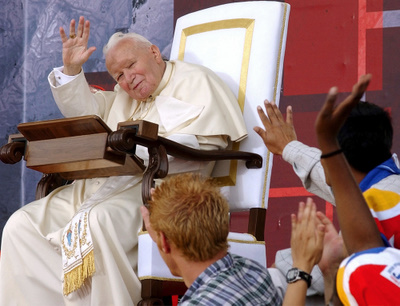
Blessed Pope John Paul the Great: Young People, YOU ARE THE SALT OF THE EARTH AND LIGHT OF THE WORLD!


2. "You are the salt of the earth... You are the light of the world" (Mt 5:13-14): this is the theme I have chosen for the next World Youth Day. The images of salt and light used by Jesus are rich in meaning and complement each other. In ancient times, salt and light were seen as essential elements of life.

"You are the salt of the earth...". One of the main functions of salt is to season food, to give it taste and flavour. This image reminds us that, through Baptism, our whole being has been profoundly changed, because it has been "seasoned" with the new life which comes from Christ (cf. Rom 6:4). The salt which keeps our Christian identity intact even in a very secularized world is the grace of Baptism. Through Baptism we are re-born. We begin to live in Christ and become capable of responding to his call to "offer [our] bodies as a living sacrifice, holy and acceptable to God" (Rom 12:1). Writing to the Christians of Rome, Saint Paul urges them to show clearly that their way of living and thinking was different from that of their contemporaries: "Do not be conformed to this world, but be transformed by the renewal of your mind, that you may discern what is the will of God, what is good and pleasing and perfect" (Rom 12:2).

For a long time, salt was also used to preserve food. As the salt of the earth, you are called to preserve the faith which you have received and to pass it on intact to others. Your generation is being challenged in a special way to keep safe the deposit of faith (cf. 2 Th 2:15; 1 Tim 6:20; 2 Tim 1:14).

Discover your Christian roots, learn about the Church’s history, deepen your knowledge of the spiritual heritage which has been passed on to you, follow in the footsteps of the witnesses and teachers who have gone before you! Only by staying faithful to God’s commandments, to the Covenant which Christ sealed with his blood poured out on the Cross, will you be the apostles and witnesses of the new millennium.

3. "You are the light of the world...". For those who first heard Jesus, as for us, the symbol of light evokes the desire for truth and the thirst for the fullness of knowledge which are imprinted deep within every human being.

When the light fades or vanishes altogether, we no longer see things as they really are. In the heart of the night we can feel frightened and insecure, and we impatiently await the coming of the light of dawn. Dear young people, it is up to you to be the watchmen of the morning (cf. Is 21:11-12) who announce the coming of the sun who is the Risen Christ!

The light which Jesus speaks of in the Gospel is the light of faith, God’s free gift, which enlightens the heart and clarifies the mind. "It is the God who said, ‘Let light shine out of darkness’, who has shone in our hearts to give the light of the knowledge of the glory of God on the face of Christ" (2 Cor 4:6). That is why the words of Jesus explaining his identity and his mission are so important: "I am the light of the world; whoever follows me will not walk in darkness, but will have the light of life" (Jn 8:12).

Our personal encounter with Christ bathes life in new light, sets us on the right path, and sends us out to be his witnesses. This new way of looking at the world and at people, which comes to us from him, leads us more deeply into the mystery of faith, which is not just a collection of theoretical assertions to be accepted and approved by the mind, but an experience to be had, a truth to be lived, the salt and light of all reality (cf. Veritatis Splendor, 88).

In this secularized age, when many of our contemporaries think and act as if God did not exist or are attracted to irrational forms of religion, it is you, dear young people, who must show that faith is a personal decision which involves your whole life. Let the Gospel be the measure and guide of life’s decisions and plans! Then you will be missionaries in all that you do and say, and wherever you work and live you will be signs of God’s love, credible witnesses to the loving presence of Jesus Christ. Never forget: "No one lights a lamp and then puts it under a bushel" (Mt 5:15)!

Just as salt gives flavour to food and light illumines the darkness, so too holiness gives full meaning to life and makes it reflect God’s glory. How many saints, especially young saints, can we count in the Church’s history! In their love for God their heroic virtues shone before the world, and so they became models of life which the Church has held up for imitation by all. Let us remember only a few of them: Agnes of Rome, Andrew of Phú Yên, Pedro Calungsod, Josephine Bakhita, Thérèse of Lisieux, Pier Giorgio Frassati, Marcel Callo, Francisco Castelló Aleu or again Kateri Tekakwitha, the young Iroquois called "the Lily of the Mohawks". Through the intercession of this great host of witnesses, may God make you too, dear young people, the saints of the third millennium!