Tuesday, March 8, 2011

INSTRUCTION ON LENT


Who instituted Lent?

According to the fathers of the Church, Justin and Irenaeus, the fast before Easter was instituted and sanctified by Christ Himself; according to the saints Leo and Jerome, the holy apostles ordained it given by Jesus.

Why has the Church instituted this fast forty days before Easter?

To imitate Christ who fasted forty days; to participate in His merits and sufferings; to subject our flesh by voluntary mortification to the spirit, and to mortify our evil desires as did St. Paul; (Col. I. 24.) to enable us to lead a pure life, and thus prepare for the holy festival of Easter, and the reception of the divine Lamb, Jesus: and, finally, to render God satisfaction for our sins, and do penance, as Pope Gregory says, for the sins of one whole year by one short fast, lasting only the tenth part of a year.

Was the fast of Lent observed in early times as in the present?

Yes, but more strictly; for the people of the early ages not only abstained from meat, but also from all that which is connected with it, such as eggs, butter, cheese, etc., even from wine and fish, although this was not the general command of the Church; they fasted all day, and only ate in the evening after vespers, in remembrance of which, vespers are now said before dinner-time, because the Church, as a kind mother, now permits the supper to be changed into a dinner, and also allows something to be taken in the evening, that the body may not be too much weakened, and become unfit for labor.

How much does this ancient custom put to shame the Christians of to-day who think the fast in our times too severe! "But," asks St. Ambrose, "what sort of Christians are they? Christ, who never sinned fasted for our sins, and we will not fast for our own great and numerous offences?"

How should the holy season of Lent be spent?

As according to the teaching of St. Leo, the main thing in fasting is not that the body be deprived of food, but that the mind at the same time be withdrawn from wickedness, we should endeavor during Lent, not only to be temperate in eating and drinking, but especially to lead a modest life, sanctifying the days by persevering prayer and devoutly attending church.

PRAYER AT THE BEGINNING OF LENT

Almighty God! I unite myself at the beginning of this holy season of penance with the Church militant, endeavoring to make these days of real sorrow for my sins and crucifixion of the sensual man. O Lord Jesus! in union with Thy fasting and passion, I offer Thee my fasting in obedience to the Church, for Thy honor, and in thanksgiving for the many favors I have received, in satisfaction for my sins and the sins of others, and that I may receive the grace to avoid such and such a sin, N. N. and to practice such and such a virtue, N. N.

Palms to Ashes: The Rite of Burning Palms


Catholic churches in the Philippines prepare today (Tuesday, March 8) for the beginning of Lent with rites that that will produce the ashes that will be put on the forehead of the faithful tomorrow, Ash Wednesday.

The ashes are produced by burning the palms which were blessed during the previous year’s celebration of Palm Sunday. Parishes usually assign the afternoon mass for the burning of the ashes. Parishioners bring their palms to the church to be thrown into the fire. The priest begins the rites with a call for the faithful to do penance and show mercy. In his opening prayer he asks “God of tender mercy … to look on us with kindness as we prepare the ashes, which will mark the beginning of our Lenten journey…”

After the opening prayer the congregation listens to the reading taken from Isaiah 58:5-10.

The priest blesses the palms while the choir sings Psalm 51.

After the palms have been burned, the priest then blesses the ashes.

On Ash Wednesday, a day of universal fast and abstinence in the Catholic Church, the ashes are imposed on the forehead of the faithful and begins 40 days of atonement of sins, doing penance and good works.

Following is the rite for the Burning of Ashes.

Palms to Ashes
In Preparation for Lent

Greeting and Sign of the Cross

    The presider makes the sign of the cross and greets those assembled, hoping that God calls the faithful to do penance and show mercy. All remain silent for a brief period.

Opening Prayer

God of tender mercy, you fashioned us from the dust of earth and bid us follow your Gospel call in the company of the Church. Look on us with kindness as we prepare the ashes which will mark the beginning of our Lenten journey. Grant that we who make the desert pilgrimage might come to the font of rebirth with a renewed passion for justice. May our alms serve your people and bring us peace, may prayer sanctify all our deeds, and may we come at last to the table you set in the place where you reign with Christ and the Holy Spirit forever and ever. Amen.

Reading

    The lector proclaims: Isaiah 58:5-10

    After the reading, a homily may be given.

Psalms and burning of the ashes

    The lector or choir leads the assembly in Psalm 51 as the palms are burned.

Blessing

    The ritual concludes with the Blessing of the Ashes.

Lord
bless these ashes [ + ]
by which we [ will ] show that we are dust.
Pardon our sins
and keep us faithful to the discipline of Lent,
for you do not want sinners to die
but to live with the risen Christ,
who reigns with you forever and ever.

    After this blessing the Presider together with the people make a procession towards the Church. The people can sing an appropriate hymn. When the Presider has reached his place in the sanctuary, he faces the people and begins the opening prayer of the Mass. Then the Mass continues in the usual manner.

FROM: http://www.rcam.org

Monday, March 7, 2011

Cardinals: liturgical abuse weakens the faith


A weakening of faith in God, a rise in selfishness and a drop in the number of people going to Mass can be traced to liturgical abuse or Masses that are not reverent, two Vatican cardinals and a consultant have said.

US Cardinal Raymond Burke, head of the Vatican’s supreme court, said: “If we err by thinking we are the centre of the liturgy, the Mass will lead to a loss of faith.”

Cardinal Burke and Spanish Cardinal Antonio CaƱizares Llovera, prefect of the Congregation for Divine Worship and the Sacraments, spoke yesterday at a book launch in Rome.

The book, published only in Italian, was written by Fr Nicola Bux, who serves as a consultant to the congregations for the doctrine of the faith and for saints’ causes and to the office in charge of papal liturgies.

The English translation of Fr Bux’s book title would be, How to Go to Mass and Not Lose Your Faith.

Cardinal Burke told those gathered for the book presentation that he agreed with Fr Bux that “liturgical abuses lead to serious damage to the faith of Catholics”.

Unfortunately, he said, too many priests and bishops treat violations of liturgical norms as something that is unimportant when, in fact, they are “serious abuses”.

Cardinal CaƱizares said that while the book’s title is provocative, it demonstrates a belief he shares. “Participating in the Eucharist can make us weaken or lose our faith if we do not enter into it properly,” and if the liturgy is not celebrated according to the Church’s norms, he said.

“This is true whether one is speaking of the Ordinary or Extraordinary form of the one Roman rite,” the cardinal said.

Cardinal CaƱizares said that at a time when so many people are living as if God did not exist, they need a true Eucharistic celebration to remind them that only God is to be adored and that true meaning in human life comes only from the fact that Jesus gave his life to save the world.

Fr Bux said that too many modern Catholics think the Mass is something that the priest and the congregation do together when, in fact, it is something that Jesus does.

“If you go to a Mass in one place and then go to Mass in another, you will not find the same Mass. This means that it is not the Mass of the Catholic Church, which people have a right to, but it is just the Mass of this parish or that priest,” he said.

By Cindy Wooden on Thursday, 3 March 2011

Sunday, March 6, 2011

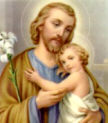
MARCH: Devotion to Saint Joseph


"Of all the people I have known with a true devotion and particular veneration for St. Joseph, not one has failed to advance in virtue; he helps those who turn to him to make real progress. For several years now, I believe, I have always made some request to him on his feast day, and it was always been granted; and when my request is not quite what it ought to be, he puts it right for my greater benefit."

— St. Teresa of Avila

QUINQUAGESIMA: Lord, let me see!


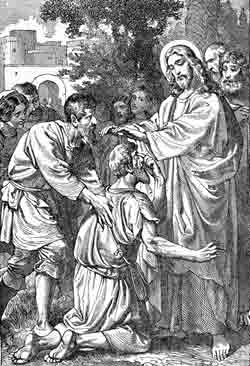
Baptism commits everyone to carry a cross, especially the cross of consistent, unobtrusive charity. As Jesus commanded the blind man of Jericho to be brought to Him, so He commands His members to bring to Him those who need Him as their light and their love. We fulfill our baptismal promises by helping others to renounce Satan and to put on Christ.

GOSPEL (Luke XVIII. 31-43.) At that time, Jesus took the Twelve aside and said to them, "Behold, we are going up to Jerusalem and everything written by the prophets about the Son of Man will be fulfilled. He will be handed over to the Gentiles and he will be mocked and insulted and spat upon; and after they have scourged him they will kill him, but on the third day he will rise." But they understood nothing of this; the word remained hidden from them and they failed to comprehend what he said. Now as he approached Jericho a blind man was sitting by the roadside begging, and hearing a crowd going by, he inquired what was happening. They told him, "Jesus of Nazareth is passing by." He shouted, "Jesus, Son of David, have pity on me!" The people walking in front rebuked him, telling him to be silent, but he kept calling out all the more, "Son of David, have pity on me!" Then Jesus stopped and ordered that he be brought to him; and when he came near, Jesus asked him, "What do you want me to do for you?" He replied, "Lord, please let me see." Jesus told him, "Have sight; your faith has saved you." He immediately received his sight and followed him, giving glory to God. When they saw this, all the people gave praise to God.

Why did Christ so often foretell His passion to His disciples?

Because He wanted to show how great was His desire to suffer for us, for we speak often of that which we crave; and because He wished His disciples when they should see Him treated as a criminal and martyred, not to think evil of Him, or imagine themselves deceived, but remember that He had foretold all minutely that all happened of His own will.

Did not the disciples understand anything of what He predicted in regard to His future sufferings?

They may, certainly, have well understood He was to suffer, for which reason Peter tried to dissuade Him from it; (Matt. XVI. 22.) but they did not comprehend why or for what He would suffer, or how He would rise again. All this the Holy Ghost gave them to understand, after it had come to pass. (John XIV. 26.) The light of the Holy Ghost is of so much value, that without it even the clearest doctrines of faith are not understood.

Why does Christ so often call Himself the Son of Man?

He wished to show, in the Jewish way of speaking, He was also man, a descendant of Adam, and that we should be humble, and not seek or desire high titles.

Why did the blind man call Christ the Son of David?

Because, like all the Jews, he believed that the Messiah, according to humanity, would be of the house of David, as was promised. (Ps. CXXXI. 11.)

Why did Christ ask the blind man: What wilt thou that I do to thee?

This He asked, not because He was unaware of the blind man's wish, but to enable him the better to prove his faith and hope that through Christ he would receive his sight; and to teach us how willing He is to help us, and how it pleases Him if we confidingly place our wants before Him. We should learn from this blind man, who would not be restrained by the passing crowd in his ardent and reiterated request, not to pay attention, in the work we have commenced, to human respect, or human judgment, but to persevere, and not allow ourselves to be led astray by the world's mockery or contempt. We should also learn to be grateful to God, and faithfully cling to Him, if He has once opened the eyes of our mind, and healed our spiritual blindness, which is far more deplorable than physical blindness, for nothing can be more miserable than not to see and understand God, not to know what is necessary for our salvation, and what is pernicious.

Why is this gospel read on this Sunday?

The Church wishes to remind us of the painful passion and death of Jesus, and to move us by the contemplation of those mysteries to avoid and despise the wicked, heathenish amusements of carnival, sinful pleasures which she has always condemned, because they come from dark paganism, and, to avert the people from them, commands that during the three days of carnival the Blessed Sacrament shall be exposed for public adoration, sermons given, and the faithful exhorted to have recourse at this time to the Sacraments of Penance and the Blessed Sacrament of the Altar, with the reception of which Pope Clement XIII. (Breve, 23. June 1765) connected a plenary indulgence. A true Catholic will conform to the desire of his holy Church, considering the words which St. Augustine spoke, at this time, to the faithful, "The heathens (as also the wordly people of our days) shout songs of love and merriment, but you should delight in the preaching of the word of God; they rush to the dramatic plays, but you should hasten to Church; they are intoxicated, but you should fast and be sober."

PRAYER O most benign Jesus, who so desired to suffer for us, grant, that we may willingly suffer for love of You; that we may hate and flee from the detestable pleasures of the world and the flesh, and practice penance and mortification, that by so doing we may merit to be released from our spiritual blindness to love You more and more ardently, and finally possess You forever. Amen.